What is beautiful is often dangerous.
Paul enjoyed the first big snow of the year but after it drifted and layered all dirty on the side of the roads, he was over it. He was ready for spring and the changing of the clocks and March Madness basketball. The power had flickered while he got dressed for work. The microwave digits off by ten minutes. He paused in front of the television to watch the morning news. Another shooting on the east side; a driver losing control into the Mohawk River, succumbing to hypothermia. Prononunced dead.
“Dang, looks bad out there,” said Paul’s wife, Diane. She put on her parka, beige turtleneck, and tapped her fingers on the countertop as she poured coffee into her travel mug. He looked at her fingernails. Last week they were purple; now the appeared maroon. She had taken out her nose ring. Thank God! Diane wasn’t a twentysomething anymore. She was almost forty.
“I’m changing my mind, going to embark through the blizzard,” she said. “You going into the office?”
“I’ll work from home,” said Paul. “I’ll clear the driveway for you.”
He opened the garage door and began to shovel a clear path for Diane to back out. He didn’t bother to clear his side of the driveway, and he watched Diane ease the Honda in reverse. One of the neighbors with a snowplow had made one or two runs down the cul-de-sac. He had no idea that it would be the last time any feelings between them would surface, as if a slow knife had punctured through their marriage. He waved bye, and for whatever reason, he thought he would never see Diane again.
He grounded some coffee beans. On the microwave, he entered the new time. He opened the front door, letting natural light through, but the gray clouds hid the sun. The neighborhood resembled Antarctica. Punxsutawney Phil had seen his shadow and retreated yesterday. At this point, Paul thought, it may not feel like spring until late April.
A melancholy feeling of dread went through him. Paul missed Spencer, the old Yorkie terrier. After thirteen years, he had to put the poor dog down in November. A bone disease left Spencer hobbling and stumbling; he was also going blind with cataracts. Spencer was Paul’s mother’s dog, and after she died in 2011, Paul took home the dog as his own.
That morning, after Diane left, the house settled in quietness. Paul thought he’d heard a dog collar rattle, a paw at the back door. Often, after losing a pet, one might hear phantom noises (one’s brain attuned to raking sounds, whimpers and squeals of yelps); little Spencer’s ghost letting his master know that he was all right in doggy heaven.
Across the Midwest the winter storm had knocked out power. A half inch of ice brought down powerlines and tree branches. The wind howled over the gutters and rooftops.
Paul and Diane had discussed moving south. “Texas,” she insisted. He didn’t know anyone in Texas, and neither did Diane. Paul thought it was a crazy idea of moving there.
He ate microwave pancakes and stared through the French doors in the dining room and watched the snow fall to the earth. Another sound of a paw at the door, coming from the front porch, but nobody was there. The sky remained dull, quiet and tranquil like a distant cloud in the shape of an angel. The snow was beautiful, but it caused so many problems and heartache for people. What is beautiful is often dangerous.
They’d only been married four years. Sometimes it felt as if it was a lifeboat in the middle of the ocean that had broken apart and they were being pulled straight into a storm. Beautiful Diane Murphy, who’d kept her maiden name, and Paul was cool with it; he didn’t care so much for his last name: “Woolworth,” that sounded like a sheep or a blanket over a person while sleeping. Or the old store Woolworth, where his grandparents had shopped.
Paul Woolworth… what a dumb name, he thought.
Paul’s boss was calling his phone.
“How are you? What a snow, eh? We don’t want you getting killed coming in. You can work remote. We need to get that final spreadsheet finished for St. Louis.”
There was a slight pause in his boss’s voice, followed by a tinge of sudden laughter from Bill Middleton, though nothing was funny. The company’s work-from-home policy took away PTO hours.
“Okay, thanks,” said Paul. “I should be good on PTO time.”
A certain fakeness resided in Bill Middleton. It was hard to figure him out.
“About that,” Bill remarked. “I have you down that you burned your last snow day last month. What you have accrued with PTO.”
Burned?
Paul wasn’t wasting it, as if he were a teenager burning through a weekly allowance.
“Obviously, your safety is number one,” said Bill. “Stay in.”
“Of course,” said Paul. “I’ll finish up the spreadsheets and send them to you this afternoon.”
“Sounds good. Stay warm, buddy.”
I’m not your buddy, Paul thought.
At forty-four, Paul Woolworth feared the next generation of workers and A.I. replacing him. Bill Middleton was younger, Gen-Z, who’d attended Yale. Gen-Z Ivy League graduates whose brains spun around like a ceiling fan on high, watching social media videos while entering data, assessing analytics, planning their meal kits all at once. They were programmed puppets within the mundane nine-to-five office hours. Paul despised these people. He wished that he could just win the lottery and be done with it.
He finished the spreadsheet tab for the St. Louis area, and Paul noticed the laundry basket in the corner of the bedroom—a reminder of when Diane snapped at him a few days ago: Please put the lid back on the Downy. You always leave it off. You hear me, Paul?
The lid was on the bottle now and he imagined Diane’s voice cracking through his skull and annoying the hell out of him. Fuck her. Hope she gets lost in the damn snowstorm. He’d forgiven the affair she had with the guy from her previous job in 2021. Paul slammed his coffee mug onto the counter and noticed a text message from his brother.
Randall texted about the apocalyptic doom coming:
Listen, I know you don’t believe me, but there’s not much time left, brother. Better get right with Jesus. You don’t want to be the ones left behind. It’s going to be hell.
Paul typed back:
Why does everything have to be about that? When there’s Mother Nature involved? Last that I checked, those children in Gaza are already in hell.
He got Diane’s exercise ball out of the closet and started working on his abdominals. He remembered her the other morning in her turquoise sweatpants, her bare feet flipping up as she balanced herself in the center. She mentioned her upcoming audits and business trips to Orlando, Atlanta, then off to Charlotte. She’d be away from him more than he anticipated.
After the ab-crunches, he laid on the floor and started doing push-ups. He was not obese or overweight, but he had a beer belly and an insatiable desire for double cheeseburgers. In front of the fireplace, he lit junk mail paper under the grate and watched the flames catch the edge of the kindling, smoke clouds flowing up through the flue.
Paul wasn’t sure where the afternoon went; time had a way of floating past him anymore, and he poured himself a rum and cola with an ice ball. As he glanced out through the French doors he saw the cluster of snow blowing across the backyard, drifting around the shed. Such nice quiet. As if seeing Spencer running through the misty whiteness of air.
Where the fuck are you, Diane? No text messages or phone calls. Had she’d planned this?Was this her moment to escape from him? Her sly intentional disappearance?
He called her cell, but it went straight to voice mail. He sent her three text messages:
Where are you?
I’m worried for you, in this weather.
Diane, it’s almost midnight. Fucking call me, please.
The numerous glasses of rum and cola and the cool-looking ice ball melted and the liquor felt prickly in his chest. What had happened next he wasn’t sure, but he remembered watching the flames in the fireplace hiss a few feet away, those jaggery red-orange flames consuming the kindling before he dozed off on the counch, the televison on low volumn. The chill elsewhere in the house made him wrap a blanket around his body.
Someone was pounding on the goddamn front door in the early morning hours. The knocking amplified through Paul’s head. He got up and thought it might be Randall (for whatever reason that he would be over at this hour, warning him about doom and gloom). “Diane?What are you doing?” Was she locked out of the house? Had she been in an accident? The doorbell now blared like a battle cry in Paul’s head.
“I’m coming. Hold your damn horses,” he yelled.
He looked around the house.
“Diane? You here?”
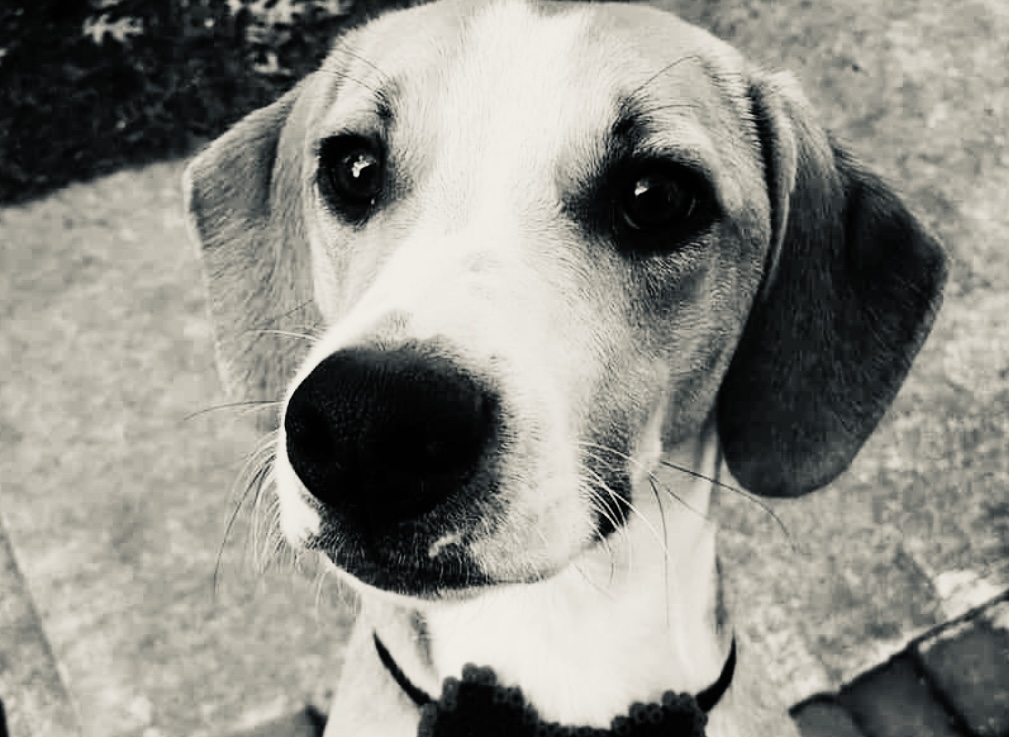
There was chatter on the porch, what sounded like a person talking to a child, and then a nick-nick sound on the storm door. Paul opened the front door and noticed the police officer standing in front of him, and beside the man, an excited hound dog with droopy ears with snow on them.
A beagle? Paul thought.
He opened the door.
“Good morning,” said the officer. “Is this your dog, sir?”
“No, that’s not my dog.”
“It’s the craziest thing,” said the officer. “I found him wandering over on Cherry Street and it ran to your front door. No collar on him. I tried to get it to come with me, maybe take it to the shelter. But he acted like this was hishome.”
“Hey pup,” said Paul, reaching his hand out, rubbing his head. He thought about Spencer, how much he missed him. He didn’t know what it meant, and he never believed in angels or fate, or if a ghost was looking out for him. Paul knew that inexplicable coincidences happened all the time—for no apparent reason.
“Well, can I leave him with you?” said the officer. “If you don’t mind? After this weather clears, I think it will be a good day. Maybe take him by the vet, check for the microchip?”
“I guess so. That’s fine,” said Paul. “I’ll take him, officer. Thank you.”
“You have a good day, sir.”
“You too.”
He hoped that the officer didn’t think he was aloof or a drunk. For a few seconds, Paul stood there exchanging glances with the dog. He grabbed a towel and dried the dog’s wet paws. For the next half hour, they played around the house with a few old toys of Spencer’s, and Paul let the beagle out in the backyard to explore the snow. He wached the hound stick his black-wet nose under the snow. In the fading gray light, where the sun tried to peek through the sky, the beagle resembled a racing stallion. He gave it water and a piece of bread. He called Diane’s cell and she answered.
“Where have you been?” Paul asked. “Jesus!”
“Long story, but I’m here, pulling into the driveway” she said.
He called for the dog and dried off his tail and paws, the French doors wide open, the air cutting a cold current across the kitchen.
“You look like a George. I’m naming you George, for now. Ha! ha!”
The utility room door from the garage creaked open and Paul stood in the middle of the kitchen, seeing Diane. She still had on that parka from yesterday; she turned her head toward him and then to George. She pulled the collar of her turtleneck away from her chin.
“Who’s this?” she asked, stepping forward to pet beagle George.
“He’s a stray,” said Paul. “An officer found him. Said he went straight to our house. Wouldn’t leave. I don’t know, what do you think? I’ll take him to the vet, see if he’s chipped. Maybe nobody wanted the little guy anymore?”
Diane bent down to pet George more, her knees and back making that popping sound that Paul heard from her when she did her exercises. “Cute dog,” she said. “You should keep him, Paul. You really should.”
“Really?”
“Look, Paul, going to just say it. Us. Our marriage. I can’t be with you anymore. I stayed at Mom’s last night and thought about us. I’m going to move out immediately. I am sorry if this hurts you. I’m sorry this is so sudden, but not going to pretend it will get better because I don’t think it will.”
He could feel his heart beat faster, as if he were part of the snow falling to the ground. He rubbed his fingers through George’s fur along his neck and muzzle and swiped away loose dirt on the dog’ spotted nose. He cleared his throat and looked back at Diane.
“If this is what you want, I’m not going to convince you to stay. I don’t like to live in a constant orb of confrontation if you’re not happy. I suspect you feel the same?”
“I do,” she said. “We’ll work on the divorce later. You can have the house, though. Not going to fight or drag anything out. But for now—”He felt his chest tighten more, a nervous feeling of being alone. The power flickered off again, briefly, and then back on. Paul and Diane looked around, up at the ceiling, as if a hawk might fly through the French doors and into the kitchen. The aqua glow of the microwave clock now blinking again, and Paul would reset it to the correct time later, before making coffee. He leaned in and gave Diane a hug, and it would be the last time they would touch each other. She would move her stuff out of the house in the following weeks, and, when spring finally came around, George had grown into a feisty, healthy hound ready to take on anything. He and George were inseparable. When he wasn’t with his beagle, the world around him felt empty, and it was not a good feeling, and Paul would stay with George as long as he could before driving to work, dealing with his boss Bill Middleton and those damn spreadsheets all day long; and as he and George both slowly gravitated toward the unknown, as though they were both at the ends of a tunnel to see a sliver of light—they found themselves in peace—moments before the next catastrophe like tornado warnings or flash flooding in or around the town. But at lease it was warming up, and this made Paul Woolworth happy.
 James W Tucker
Leave a comment